Nervous system fragrance that works in seconds.
You're wired, foggy, or scattered. Aerchitect uses scent to help shift the state before you have to think your way through it.
Crafted as fine fragrance. Used as a tool.
Shop the Toolkit →5.0/5 from 101 reviews · 30-day returns · Ships in 1–2 business days

"CALM is exquisite and addictive and ... undeniably calming."
-- Jean Godfrey-June, Executive Beauty Director, Goop,
Godfrey's Guide, Substack
"A mood treatment disguised as a luxury perfume — I spray it on whenever I need to mellow out a little (or even when I don't, because it smells that good)."
-- Andrea Linett, co-founder, Lucky Magazine,
I Want To Be Her! Substack
Spray. Breathe. Your nervous system follows.
Scent reaches the brain faster than thought, so the shift starts in seconds, not minutes — and because the response is involuntary, there's nothing to get wrong. Use it on the move or take a beat with it. Both work. And the effect compounds the more you use it.
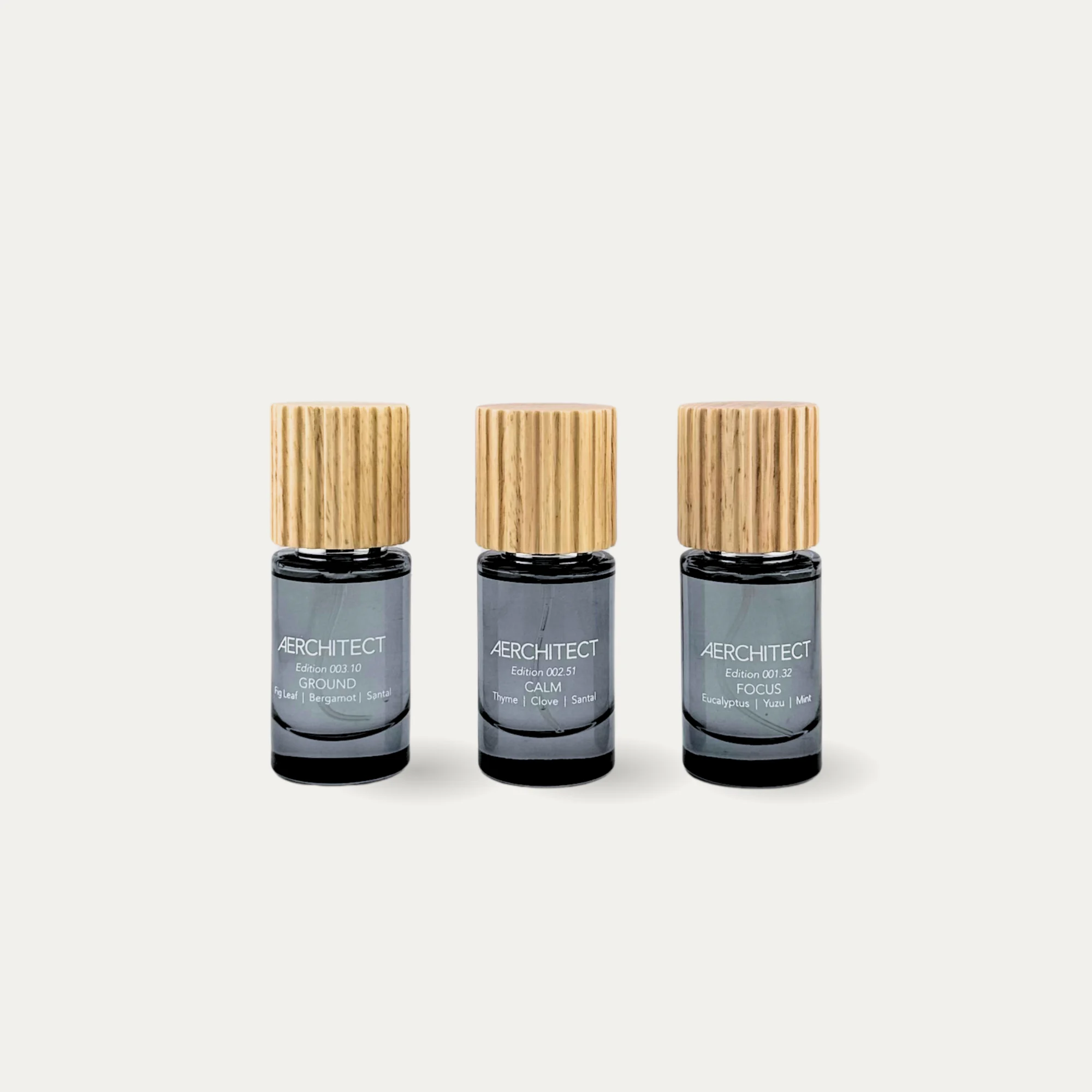
Mood Toolkit · 3 × 30ml · $95
Three states. One toolkit.
Start here if your day moves through more than one state. Reach for the mist the moment calls for and learn the pattern your nervous system runs.
Running hot
CALM
For mental noise, stress, and sympathetic overdrive.
Foggy or depleted
FOCUS
For attention fragmentation and context-switch recovery.
Scattered or not quite here
GROUND
For transition residue and coming back to the present.
30-day satisfaction guarantee · $5 continental US shipping
#7 in Thingtesting's Best of Fragrance · As seen in Business Insider, Cool Material, LA Yoga, and TrendHunter
"I keep FOCUS on my desk. It's the only thing that gets me through back-to-back Zooms without losing my mind."
"CALM in a bottle.
My new go-to between meetings."
"Finally—a product that respects that I don't have 20 minutes for a self-care ritual."
State Finder · 6 questions · 2 minutes
Too loud, too foggy,
or not quite here?
Name the pattern before you choose the mist. The State Finder points you toward CALM, FOCUS, GROUND, or the full toolkit.
Find your state-
Loading…
-
Loading…
-
Loading…
-


The micro-reset.
Each mist works on its own. Pair it with a short practice when you want to go deeper — optional, never required. Either way, the scent does the work.

How We Make It
Small-batch production. IFRA-compliant fragrance oils. Sustainably sourced botanicals. Premium glass bottles.
No phthalates. No parabens. No dyes. No bullsh*t.
Every mist is made with control, intention, and respect for your nervous system—and the planet.
When to Reach for Functional Fragrance


The state changes. Your reset stays close.
CALM for overdrive. FOCUS for the fog. GROUND for the re-entry. Three fine-fragrance mists built for the transitions inside a real day.
Shop the Toolkit →Field Notes
-
Read more: Vagus Nerve Mist: What It Is and How to Use One

Vagus Nerve Mist: What It Is and How to Use One
A vagus nerve mist is a scent-based regulation tool that influences vagal tone through the olfactory pathway, rather than through direct electrical stimulation of the nerve. The compounds in the mist reach the hypothalamus within seconds, which in turn modulates the brainstem nuclei that control parasympathetic output. Used consistently, the cue itself starts the shift before the chemistry has finished acting.
Read more -
Read more: Upstream of Burnout: Designing Conditions Instead of Recovering From Them

Upstream of Burnout: Designing Conditions Instead of Recovering From Them
Almost all wellness is recovery-based: deplete, then repair. It sells you the repair. There's an upstream alternative — design the conditions so the depletion doesn't accumulate in the first place. That's a different practice and a different kind of person: someone who architects their conditions rather than endures them, and treats the instrument as one part of a designed life, not a rescue.
Read more -
Read more: The Regulated Workspace: Engineering the Desk as a Transition Environment

The Regulated Workspace: Engineering the Desk as a Transition Environment
A workspace isn't one state — it's a sequence of transitions: into deep work, out of a meeting, through the afternoon dip, across the boundary home. A regulated workspace engineers those transitions instead of leaving them to chance, using scent as the instrument that marks and triggers each one at the desk. This is the space-side of workday regulation: not what you do across the day, but what the desk itself is built to carry.
Read more


